
Starting a photography business in Australia? Here’s how to find your niche and why it matters
You’ve got the eye, you’ve got the gear, and people keep telling you your photos are incredible. At some point the question shifts from ‘should I do this?’ to ‘how do I actually make it a business?’
In this guide we will walk you through the basics of setting up a photography business in Australia, how to find your niche, and why it matters.
How to start a photography business: A checklist
Getting the business foundations right takes less than you might expect. Here is what you need to do before you send your first invoice.
Apply for an ABN (Australian Business Number)
Register for free through the Australian Business Register. You will need an ABN to invoice clients legally and to be treated as a business (not a hobbyist) by the ATO.
Decide on your business structure
Most photographers start as sole traders. It’s simple, cheap to set up, and you report your business income on your personal tax return. If you’re going into business with a partner or want more formal separation between personal and business liability, talk to an accountant about a company structure. However, being a sole trader is the right starting point for most.
Choose a business name
If you’re trading under anything other than your own legal name, register your business name through ASIC. It costs around $40 for one year or $95 for three years. Still trying to come up with the right fit? Read our tips for naming your business.
Set up your bank account and basic bookkeeping software
Keep your business income and expenses separate from day one. A dedicated business bank account and a simple invoicing tool will save you a lot of stress at tax time.
Photographers’ insurance
You should have photographers’ insurance before taking on any paid work. At minimum, you will need public liability insurance. Depending on your niche, professional indemnity insurance may also be a necessary investment. The risk profile varies quite a bit depending on what you shoot and how you work, so it’s worth understanding that before you pick a policy. AUZi Insurance has photographer-specific cover you can quote and manage entirely online at auzi.com.
Once you’ve made it through this checklist, you’re ready to focus on the part that shapes your business: your niche.
Why your photography business needs a niche
A lot of new photographers try to offer everything from weddings, portraits, real estate, events and even products. The result is a portfolio that doesn’t speak clearly to any one client, and a website that ranks for nothing in particular.
Picking a niche doesn’t mean you can never take other work. It means you become known for something, which makes marketing easier, referrals more likely, and your pricing easier to defend.
Here is an honest look at the main niches available to Australian photographers right now.
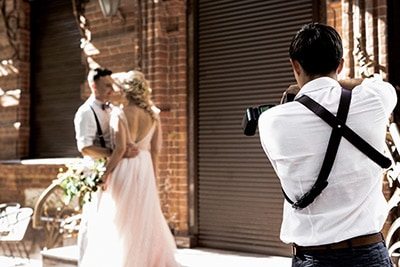
Wedding photography
Who it suits: Photographers who stay calm under pressure, connect easily with people, and are happy working weekends for most of the year.
Client type: Couples planning one of the most emotionally loaded days of their lives. Expectations are high and there’s no reshoot.
Gear investment: High. You need two camera bodies (one as backup), a range of lenses, off-camera flash, and reliable storage. Budget $8,000 to $15,000 to start properly.
Risk profile: High. Miss a key moment, lose footage, or have equipment fail at the wrong time, and a client could seek compensation. Professional indemnity insurance is genuinely important here, not just a formality.
Income potential: Strong. Experienced wedding photographers in Australian capital cities regularly charge $3,000 to $6,000 per booking. The ceiling is high, but so is the time investment per job once you factor in editing.
The reality: It’s a competitive, reputation-driven market. Second-shooting for established photographers before going solo is the smartest way in.
Pet photography
Who it suits: Patient photographers who genuinely like animals and can roll with unpredictability.
Client type: Pet owners who treat their animals as family. It’s a feel-good niche with loyal clients who come back and refer their friends.
Gear investment: Moderate. Fast lenses and a good burst mode matter more than elaborate lighting. A solid mid-range mirrorless kit is enough to start.
Risk profile: Lower than weddings, but animals are unpredictable. If you’re shooting in people’s homes or public spaces, public liability cover still matters.
Income potential: Growing. Australia has one of the highest rates of pet ownership in the world, and spending on pet-related services has climbed steadily. Rates per job are lower than weddings, however repeat business and word-of-mouth referrals are strong.
Real estate photography
Who it suits: Photographers who prefer a structured, repeatable workflow over creative spontaneity. Early starts are common.
Client type: Real estate agents and property developers who need consistent quality and fast turnaround. This is a B2B relationship, not a consumer one.
Gear investment: Moderate to high. Wide-angle lenses, a sturdy tripod, and editing skills for HDR blending and sky replacement are expected. Adding drone capability (see below), significantly increases your earning potential.
Risk profile: Moderate. You’re regularly working inside other people’s properties. Public liability cover is worth having.
Income potential: Reliable rather than spectacular. Though experienced real estate photographers in metro areas can earn well by shooting multiple properties per day. Drone footage and virtual tours push your rate per job much higher.
Drone and aerial photography
Who it suits: Technically minded photographers who are comfortable with regulations, flight planning, and the responsibility of operating aircraft in shared airspace.
Client type: Real estate agents, construction companies, tourism operators, events, and film and TV production.
Gear investment: High. A commercial-grade drone like the DJI Mavic 3 Pro starts around $3,000 before accessories, spare batteries, and storage.
The licensing requirement you cannot skip: In Australia, flying a drone that weighs more than 2kg for commercial purposes requires a Remote Pilot Licence (RePL) issued through CASA (the Civil Aviation Safety Authority). That means training with a certified provider, a theory exam, and a practical flight assessment—a process that takes several weeks and costs $1,500 to $3,000 depending on the provider.
Drones under 2kg used commercially have fewer formal requirements, but you still need to follow CASA’s standard operating conditions and register your drone if it weighs over 250g. Recreational rules are different from commercial rules, and the moment you’re charging a client, it’s commercial—regardless of how casual the arrangement feels.
Risk profile: High. Drone incidents can cause property damage or personal injury. Aviation-related cover is a separate consideration from standard photography insurance, so it’s worth talking through your specific situation with a broker before you start taking commercial work.
Other photography niches worth considering
Newborn and family photography is a warm, referral-driven niche that works particularly well in suburban markets. It requires patience, a safe studio setup, and a gentle approach, especially with newborns.
Product and commercial photography suits photographers with a studio mindset and an interest in working with brands, e-commerce sellers, and food businesses. It is less glamorous than weddings, but often more consistent as a source of income.
Once you've picked your niche, get insured
Your photography niche shapes your risk profile, your gear list, and the type of clients you will work with. It also shapes the insurance cover that applies to your business.
Before you take your first paid booking, make sure you’re operating as a real business, not just a talented hobbyist with a camera. That means holding an ABN, a business name if you need one, and having the right insurance.
AUZi Insurance has occupation-specific cover for photographers that you can quote and manage online, with licensed brokers available if you want to talk through your specific situation first. Get a quote and place cover today.